
Prep for and Manage Back-to-School Congestion Changes with Iteris ClearGuide
 4 min. Read
• Posted
08/25/2026
by
Jeff Venables
4 min. Read
• Posted
08/25/2026
by
Jeff Venables

As the school year resumes across the country, local communities are facing increased congestion and a substantial uptick in the presence of vulnerable road users around school zones, creating new safety and mobility challenges. Thankfully, with the right tools, many of these changes are foreseeable.
Iteris ClearGuide® lets agencies easily compare congestion levels from two or more time periods to gain insights on traffic changes ahead of time as well as during these periods, to better deploy countermeasures around schools with substantial congestion hotspots.
The ClearGuide traffic analytics solution provides appropriate granularity for the task at hand. In the case of schools, it’s sensible to drill down on Monday through Friday, with weekends and any holidays excluded from the analysis. Further, ClearGuide Time of Day reports let users choose the precise hours relevant to schooltime commuting. In this case 6 am to 8 pm should well cover the peak periods for vehicular and foot traffic.
Eleanor Roosevelt High School in Eastvale, California is in many ways a typical school, with bedroom communities around it and a fairly well trafficked arterial running along its eastern edge. (The City of Eastvale is not a ClearGuide customer.)
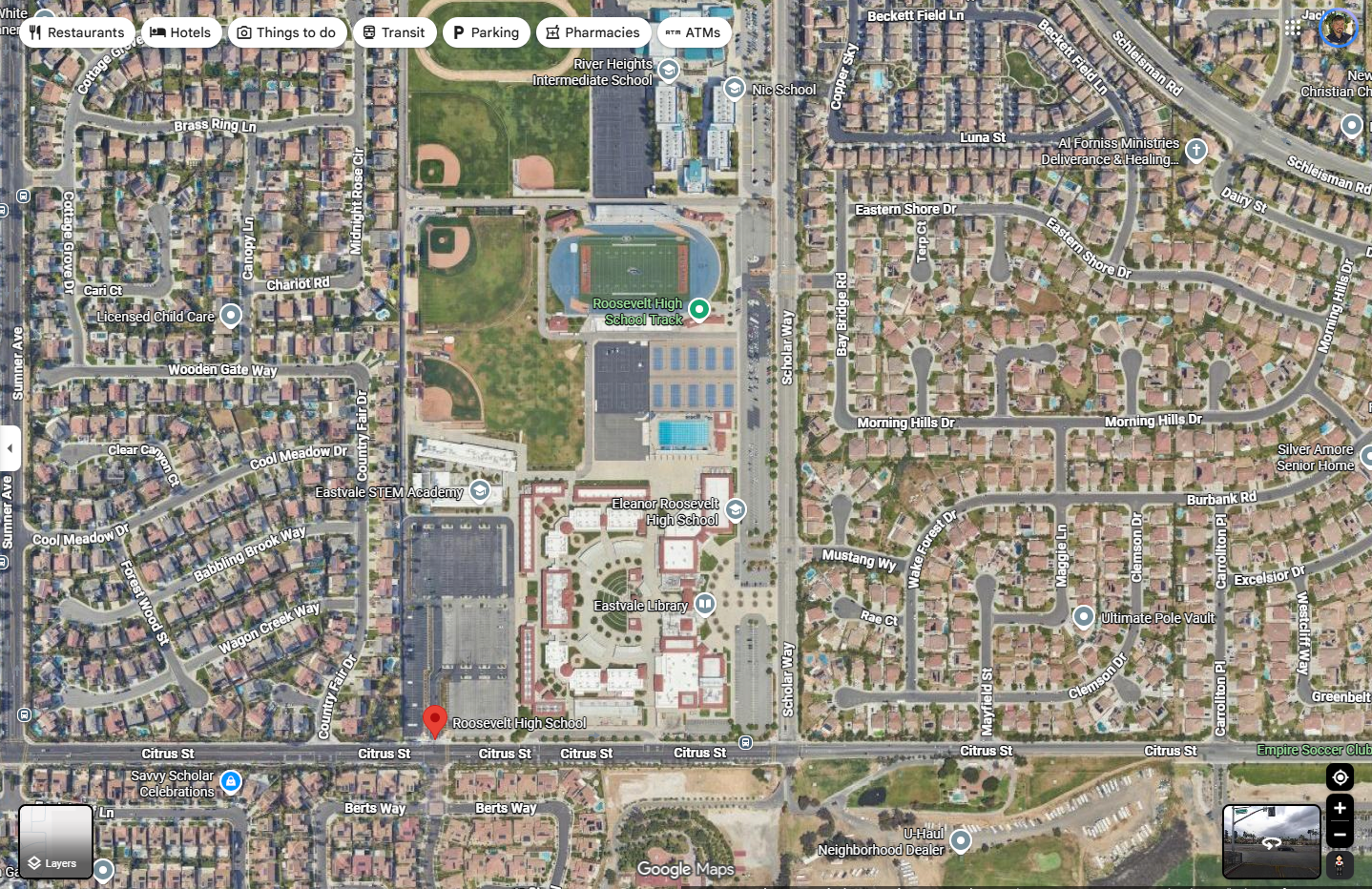 Roosevelt High in Eastvale, California.
Using ClearGuide, we can look at a key adjacent intersection to examine changes in traffic volume as the new school year begins. Last year, the Scholar Way/Mustang Way intersection at Roosevelt High saw significant increases in delay and queue length at this intersection from the heart of summer to the school’s opening.
This report compares the delay in the north-, south-, east-, and westbound lanes in July to delay for the month after Labor Day in 2025. The westbound approach peaked at 85 seconds at 9 am during the school month, compared to 46 seconds over the summer.
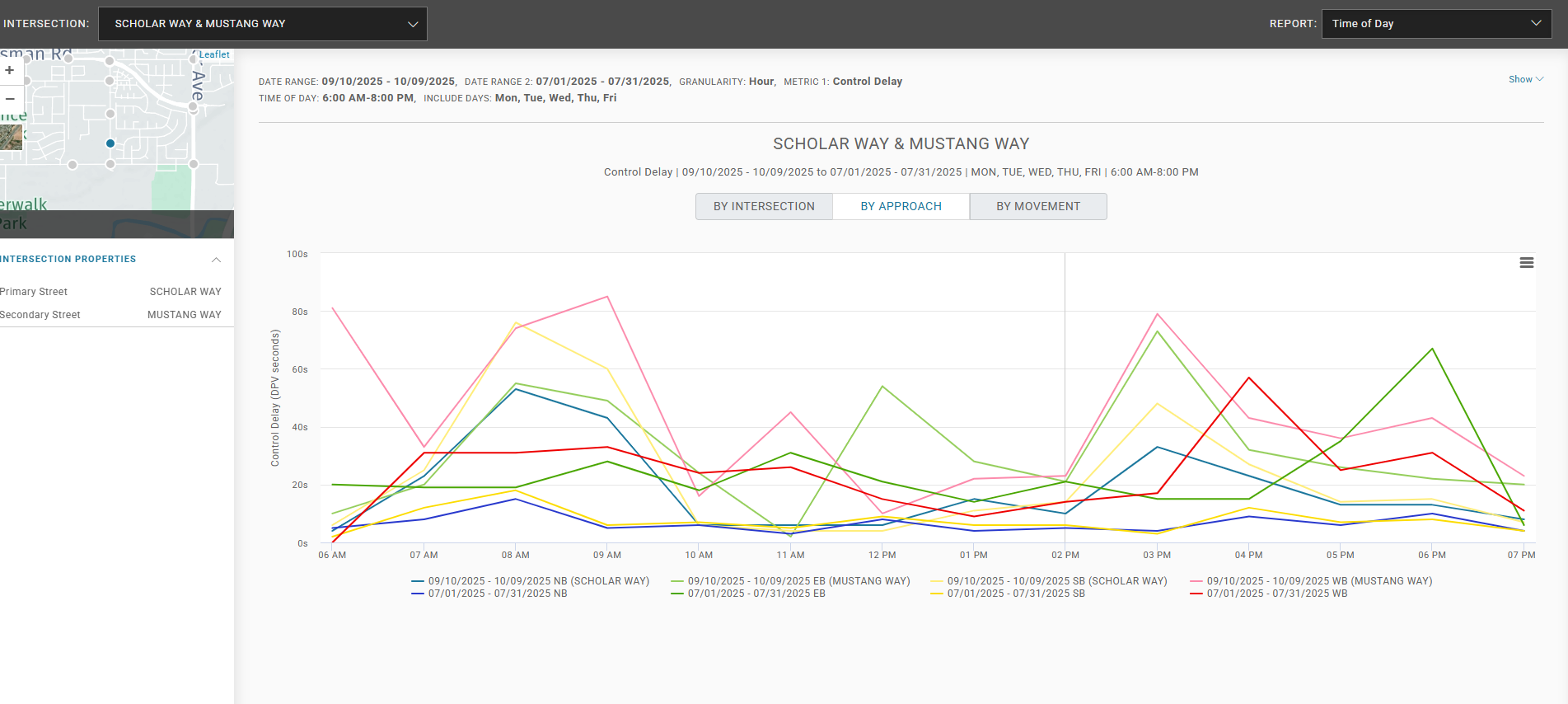 Intersection delay in seconds at Roosevelt High before and after school started last year. The lighter of each two sets of colors represents the month school was back in session.
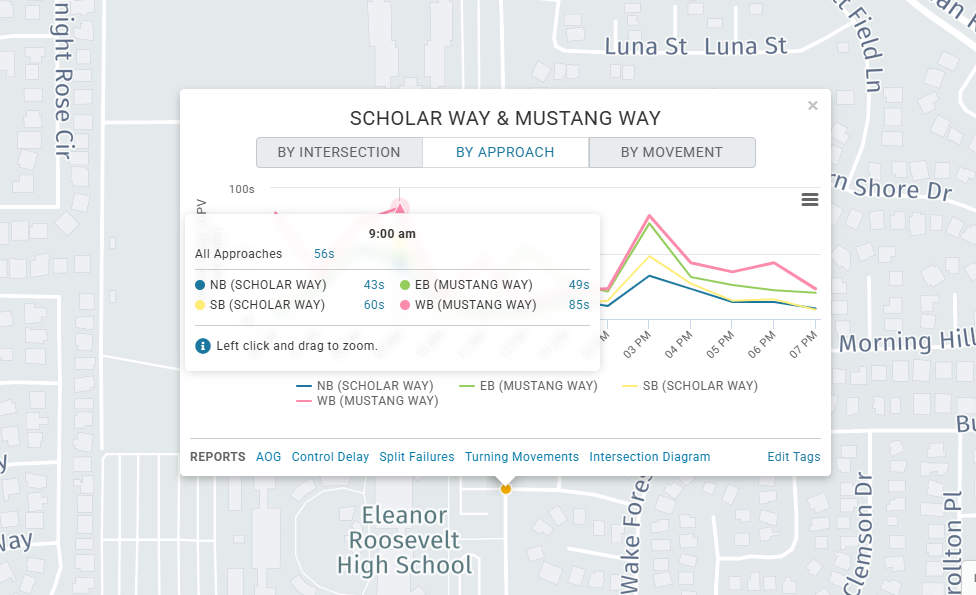 The 2025 morning spike in control delay, by intersection approach.
Now let’s turn to the 2026 school year. The following report compares data from this summer to back-to-school only through August 24. And yet the westbound approach’s delay at 8 am on schooldays is 86 seconds compared to just 28 seconds in the month of July, an increase of more than triple.
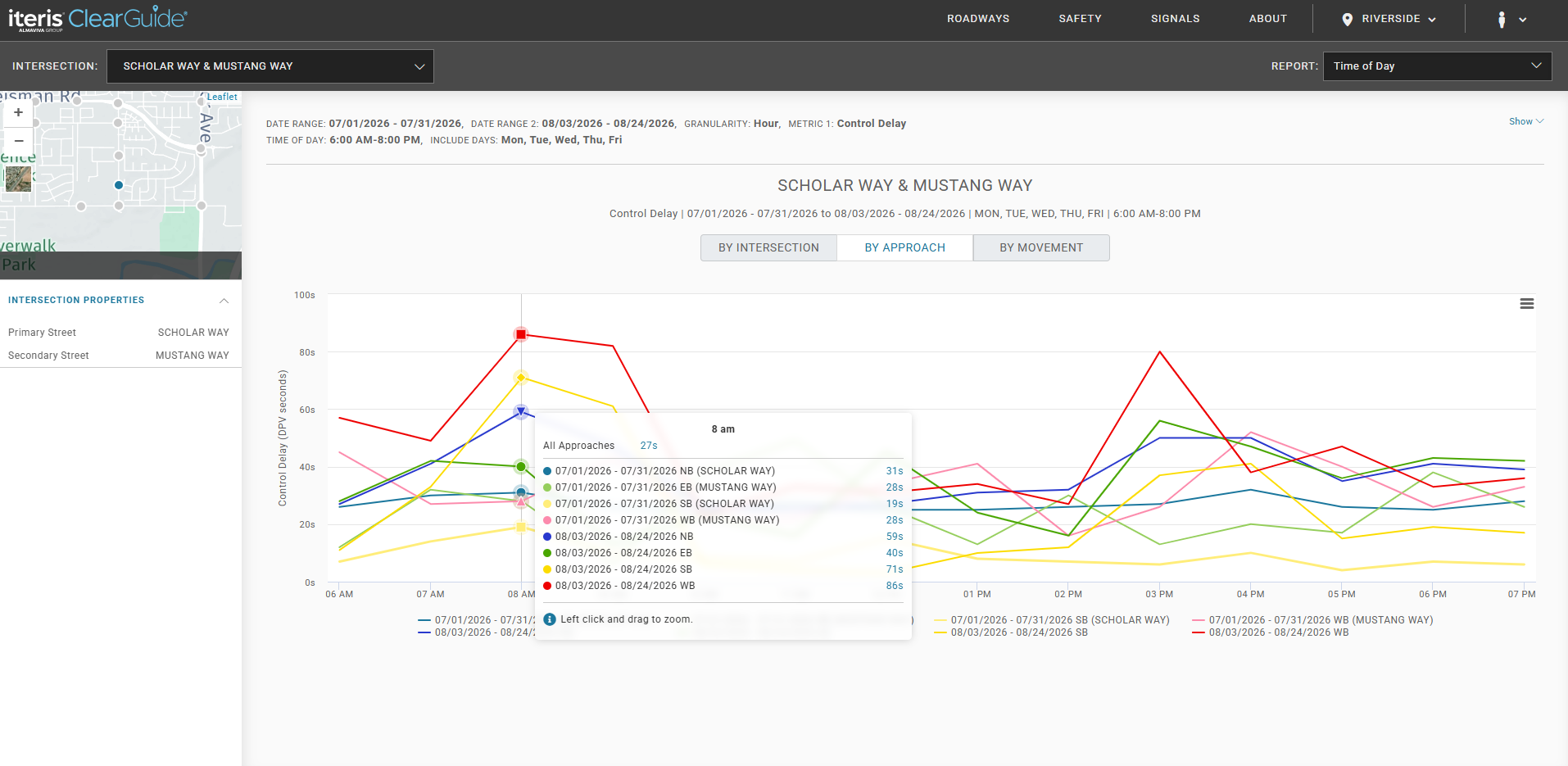
Peak control delay has already more than tripled since school began this year.
Predictably, the peak hours of delay are 8 am and 3 pm, exactly as expected since these are the times of day vehicles are moving the greatest number of students to and home from school.
A split failure occurs when vehicles get stuck waiting for more than one signal cycle before crossing an intersection. This year, the split failure rate at Scholar and Mustang Way soared from just 9% over the summer to 30% at its peak eastbound approach at 8 am on school days.
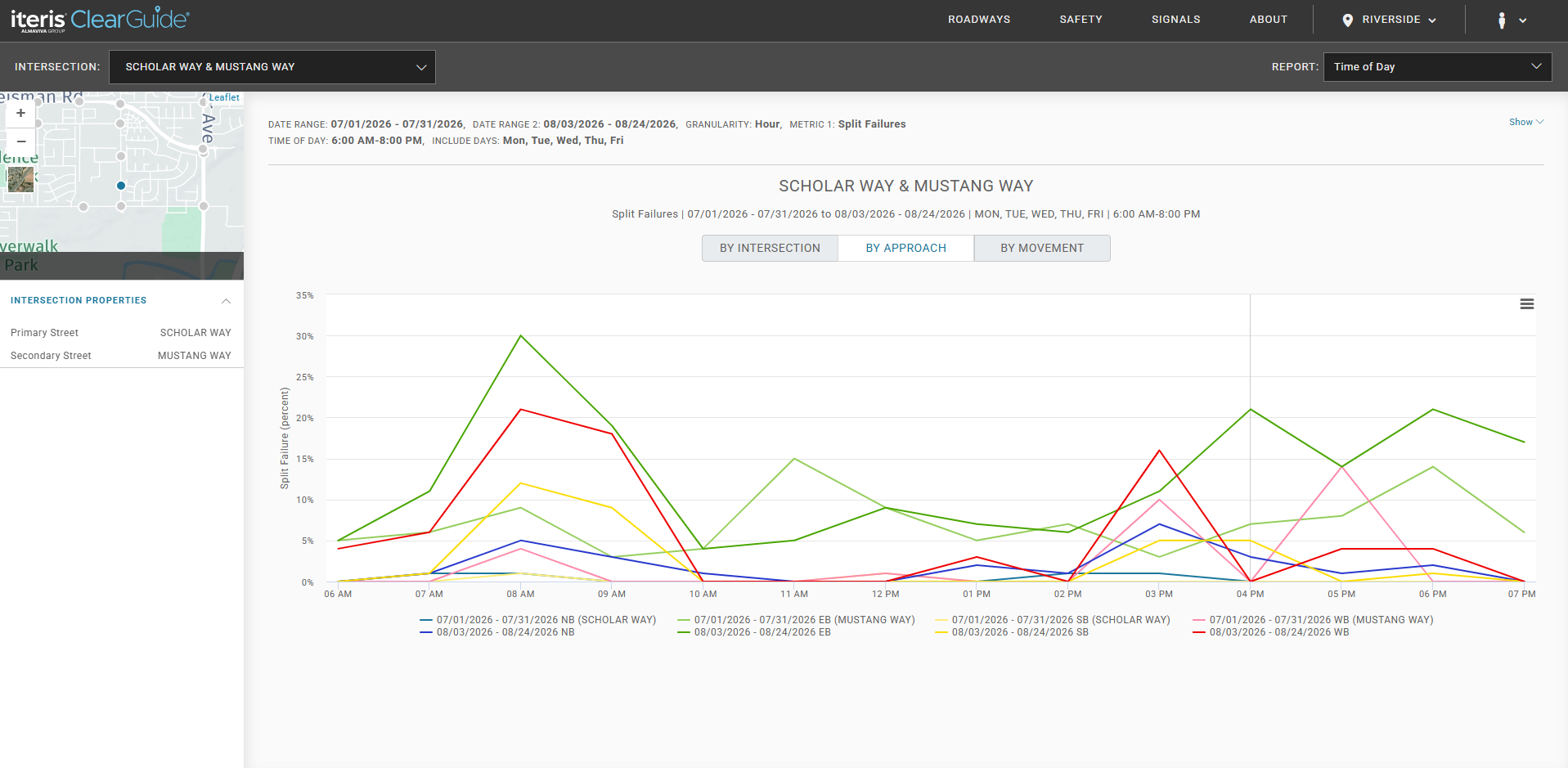 At 8 am on weekdays, nearly one in three eastbound vehicles were stuck through more than one signal cycle at the start of this school year.
Mustang Way is a small, semi-private enclave road. Split failures should not occur there at all, much less an astonishing one in three cars unable to advance through the intersection after waiting at least one full signal cycle.
Roosevelt High is a fair example of a typical school and the increases in traffic congestion and volume schools all over the country face at the start of each academic year. As we see with the modest side street that intersects with Scholar Way, these are also too often the intersections least equipped to handle the sudden changes.
With ClearGuide, it’s possible to accurately see what has happened in the past, what is happening now, and what is likely to happen in the future around schools in the months ahead, allowing agencies to put signal timing, alternate route info, and other congestion hotspot countermeasures in place.
 X
(Twitter)
X
(Twitter)
 Facebook
 LinkedIn
 Copy
Link
Copy
Link Email
EmailRelated Posts

Watch: Why the Future of Transportation Depends on Hardware and Software Working Together
2
min. Read
• Posted
08/11/2026
by
Ahmad Jawad

What’s Driving the DRAM Shortage – And What It Means for Transportation Technology
4
min. Read
• Posted
07/23/2026
by
Todd Kreter

ITS America 2026: Real Conversations, Real Momentum and What Comes Next
3
min. Read
• Posted
06/23/2026
by
Mike Plata